Clip Description
Active Involvement /Engagement
My goal is to transition the students from thinking about my writing to applying the visualization strategy to their own writing. After the modeling and a short, guided practice, I hoped students could apply the strategy independently. The active engagement was difficult because the student work was in different stages - some students needed to think ahead to an important part, while others had already written about an important part. Despite that, students had a chance to hear me explain the strategy again and to hear a classmate share his or her application of the strategy. Most students held up fingers to show that they thought of actions to include in their stories.
During this clip, Chelsea looks for a part she might want to stretch. She identifies one and then visualizes actions in that part. Instead of asking partners to switch immediately, I decide to ask Chelsea to share aloud the actions I heard her sharing with her partner. Normally, I would do this after both partners had shared, but I realized this was a good opportunity to provide an example for students who needed more support.
Transition to Independent Work
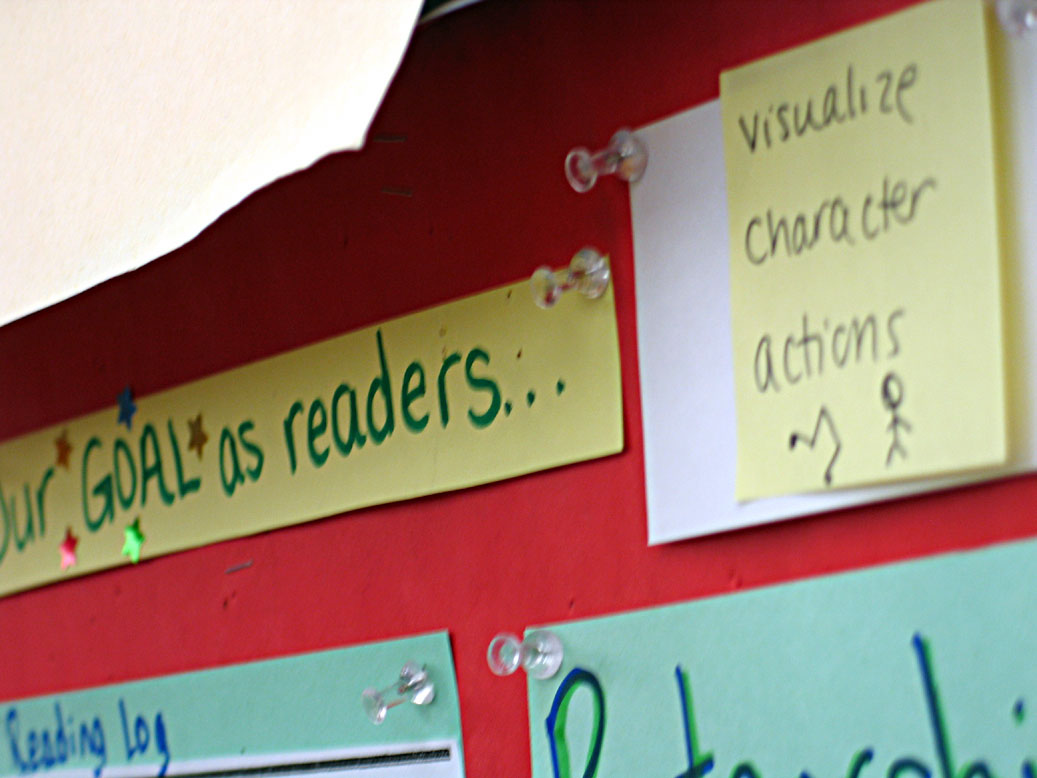
As I send the students off to do their independent work, I restate the teaching point in the context of our daily writing goal. Many students noticed that, in this case, our writing goal is connected to our Readers Workshop goal from earlier that (see photo). I also mention that a writer who tried to use the visualization strategy would be invited to Author's Chair. Generally, I mention Author's Chair if I feel that the daily goal is something that I think everyone can try. Because our daily goal isn't necessarily relevant to ALL the children all of the time, on some days I don't want to pressure everyone to use what I've taught.
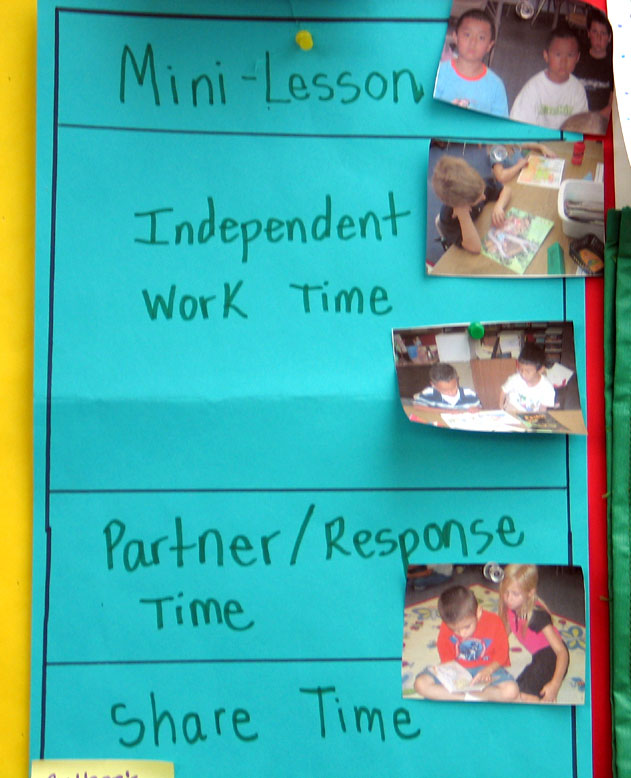
Toward the end of this clip, I refer to the "work time" chart, a new chart made specifically for this Writers Workshop unit (see photo). We recently added "response time" to the chart, and many students found the visual chart helpful as they worked. Many are excited to share and needed a reminder of when response time would be coming.
Commentary
My role during the active engagement piece
While students identified important parts and visualized actions, I observed the class as a whole rather than checking in with specific students. I hoped that by observing the "big picture" I would get a sense of who was understanding and who I would need to check-in with during the partner share portion. By listening during the first part of the sharing piece of the active involvement, I realized that some students were having difficulty applying visualization to their own piece - understandably, as this was their first attempt.
Will this particular demonstration support all of my students as writers?
Thinking about the wide range of writers and their needs, I could have included a non-example in this particular lesson, which might have been helpful for some students (e.g. the details I was omitting because they were not important to my story). In addition, I know some of my writers think about their writing in larger scenes and may have benefited from watching me work through drafting in this way, but mini-lessons are intended to give each writer something he or she can try to use in his or her own way.
The literacy language I use when teaching...
I am trying to find a balance between using consistent language to describe strategies with using a variety of descriptions. Some students hold onto particular language. I want to give them options but still remain focused. I have found it especially helpful to use similar terms in the reading and writing work as I connect the strategies. In this particular lesson, the "stop and visualize" strategy is very similar to the "stop and think" strategy that students use to visualize while reading. I hope that making these connections between reading and writing will help students apply the strategies in their own writing.
Transcript
| TEACHER: |
So I'm going to show you how I did this yesterday with my piece after you went home, okay, because I've been working on my piece, remember? So I want you to watch while I show you how I stop and visualize the actions and put them into my story. And I know that good readers reread their stories before they start writing again to make sure that, you know, to get themselves back into the story. You know, dive back in, like we talked about. So you can just watch and listen while I read and reread my story.
Crash, splash. The waves crashed onto the shore. I stepped onto the warm sand. I smiled as the sand touched my toes. We were at the beach. This is going to be a great day. "I'm scared, " I said. I did a deep breath, I looked at the water and - and I got to this part and I did my new strategy of stopping and visualizing. So I stopped and I was visualizing what I did. I remembered that I was quickly stepping down towards the water, okay. Step, step. I took quick steps down to the water. I took quick steps down to the water and I let my breath out slowly. Remember, I took my deep breath. Okay. So now I wrote down, step, step, step. I took quick steps toward the water and let my breath out slowly. This is an important part because remember, in my story I'm trying to show, yes, it's an important part. Because this was leading up to this important part and the reason it's important, remember, is because this is the part where I'm starting to try to be very brave and go in the water. So I - did you see how I visualized the action? And then I wrote them down in my story. Now I'm going to stop again and I'm going to visualize what happened next. And I'm closer to the water and then a wave chased me back up to the sand. So I'm at the water and then like the wave chased me back up to the sand, the dry sand. I remember it felt really dry because I'd just been close to the water where it was wet. So I ran back to the dry sand and stopped. Okay. I'm going to show you the reason I stopped at that point is because what we're going to try to do is visualize maybe two or three actions and then stop again. So my two or three actions were one, I ran - I got closer to the water, two, the wave chased me back, and then three, I stopped and I can see Christina is really trying to follow that. Very good. So since I have two or three actions, then I go and I write those actions down, just so I don't forget them. I got closer to the water and a wave chased me back onto the dry sand. I stopped. I saved this part for you to get to watch me. Okay, so now I'm at the part where I'm back up on the sand. I'm trying to remember. I'm going to try two words. You can hold up your fingers if you want to. I'm going to try to visualize two word actions. So I took another deep breath and I tiptoed down to the water and stepped in. So I took another breath. I tiptoed because I wasn't quite sure. I was not feeling very, very brave then. Tiptoed to the water and stepped in. So if you saw how I stopped and visualized two or three actions and then wrote them down. Give me a thumbs up. If you saw how I stopped my writing, visualized two or three actions and then what goes after this step? |
| STUDENT: | Like when you're writing you stop and want to think what happened. |
| TEACHER: | Okay, thumbs down. Now it's your turn to try. |
Related Work
Chelsea writes and chats (video/.mov)
Download Rachel Rothmann's Lesson Plan (pdf)
Download Chelsea's Story (pdf)