Clip Description
Immediately following the lesson, Becky agreed to reflect about her teaching that day.Commentary
What is Reflection?(from Johns Hopkins University's statement on Professional Development)
Reflection has many definitions in the context of teacher cognition. Reflection involves "a state of doubt, hesitation, perplexity, or mental difficulty, in which thinking originates". This uncertainty is followed by the act of searching to find materials that will resolve this doubt and settle the perplexity (Dewey, 1933).
Reflection, however, is more that "just thinking hard about what you do" (Bullough and Gitlin,1995). Reflective practitioners give careful attention to their experiences and how meaning is made and justified. They analyze the influence of context and how they shape human behavior.
Critical reflection goes beyond the technical aspects of an experience to the personal, ethical, and political dimensions of teaching. Reflection is about social justice, equity, and change. Reflection is inquiry into pedagogy and curriculum, the underlying assumptions and consequences of these actions, and the moral implications of these actions in the structure of schooling (Liston & Zeichner, 1987).
Becoming reflective requires active engagement or consciousness in the experience, and in this case, the act of narrative writing. Reflection requires the ability to analyze and prioritize issues, to use tacit and resource-based knowledge, and to develop a feasible plan of action. Clarke (1995) suggests that reflection is not about a single event in time, but occurs over time as teachers begin to construct meaning for themselves.
Transcript
| TEACHER: | Well, I think overall the lesson went well. I think they understood that they were to think a little bit more deeply about the topics that they have selected, but as I anticipated it being hard, it was hard. And the thing that I noticed a lot of them doing was just saying that they had selected it because that was the topic that had a lot of feelings or that had things that they could write more details about. So some of them did miss the, why is it important to me? But I hope with - and so it's something that I'll probably revisit tomorrow a little bit more and refer back to the kids that I had share at the end, what they were able to do as a result of our conversation together, and hopefully they can try on that conversation without me but pretending as if I was asking them those questions of why, what was really important. But I did anticipate that that would happen today and I knew that it would be something hard because it was hard for me as I tried it on myself. |
| VISITOR: | What did you see in your writing conferences with students? |
| TEACHER: |
Most of them had tried it on. Some were more successful than others were, but then as a result of our conversations together, we were able to dig a little bit deeper and a lot of them - it was like, especially with little Brandon and Aaron, that I was here on the carpet with. Brandon, it became really obvious when he got it. He was confused at first when we started talking and I found myself just stopping my conversation because he didn't need any more instruction. He knew what he needed to do and what he had not done correctly.
But others, it was a little bit harder to - Aaron was a little bit harder and he was talking about practicing at the park with his dad and then finally the, well, I scored three goals that day, came out. And so I don't think he would have got that on his own if he hadn't said that to me and if I hadn't reacted the way that I did with him. I'm not sure he would have gotten that that was what was really important about that particular day on the playground. It's going to be hard as I really try to meet with everyone and make sure that they've got some significance in the event that they selected |
| VISITOR: | What surprised you about today's events? |
| TEACHER: | I'm not sure that I was really surprised by what happened. I anticipated it being hard, I anticipated a few of them getting it and the ones that I thought might were pretty close, and the ones that would struggle, did. I guess I was surprised though that the - I won't call it a mistake because it's not necessarily a mistake but the commonality amongst the students in their response to the question, in that a lot of them said, "It was important to me because it had feelings," or, "It was important because I had a lot of details to share." So I guess I was surprised by that response, that specific response and that so many of them had went that direction. So yeah, I guess I was a little surprised by the commonality of the responses. |
| VISITOR: | And what changes did you need to make in your plan as you went along, if any? |
| TEACHER: | Well, I guess just the fact that I wasn't necessarily expecting them all to go the route of, well, it had lots of feelings or it was something that had a lot of details in it. So I just found myself having to kind of think really quickly about what kind of questions I could ask them to get deeper than that. Okay, so what were the feelings? Was it, you know, that you were scared? Was it that you had been brave for the first time? Was it that you were shy but you realized that you didn't have to be shy and that it was okay to be proud of what you were doing? So I guess, yeah, just kind of shifting my thinking in the questions that I was then needing to ask them to get at what was really important. |
| VISITOR: | What did you see in the pieces of student work that were generated? |
| TEACHER: | I saw the try. I mean, a lot of them really did try to think a little bit deeper about their event and why it was important to them. So that was cool for me to see. [inaudible] just the need for me to figure out some different questions that I can ask them so that they are thinking more about the significance of the event. |
| VISITOR: | And was there anything in the student work that surprised you and if so, why do you think those things happened? |
| TEACHER: |
I'm trying to think of particular students that I - I was actually really surprised of - Christine was one of the ones that I had conferences with and when I approached her I was anticipating that I was going to need to question and talk through more deeply because she is a shy little girl and often we have to kind of rework some of the things that she’s doing. But she nailed it today. She really was able to tell me – she wrote about the time when she was in a wedding. She was the flower girl in a wedding and she was able to explicitly say, "This was the first time I’d ever been in a wedding. I was the flower girl. I was really shy." But then she ended her little piece that she wrote about why it was important by saying that she realized she didn’t have to be shy. And I thought that was really big for her to be able to be that successful today.
But a lot of it too is the choice of event because that is something that’s a little more uncommon than when you lost a tooth. Some of them have chose to write about that, and most of them have lost six or seven teeth by now. So for them to really zero in on, you know, the one time that they lost a tooth. So I think our topic choice lended her to quite a bit of success today. And Celia too actually surprised me a little bit in her ability to describe her feelings that they felt in her stomach. She said that she had that flip floppy, wiggly feeling, and I thought that was – that was great that she was able to include that in her writing, even as – you kind of tied in with the importance because it was the first time she’d seen the fire truck up close and it was the first time that she realized how loud the sounds were and how bright the lights were and then was able to put her inside – her gut feeling, into all of that too and how that affected her. So I was surprised by that too, that she’d done a really good job. |
| VISITOR: | What will you do in your next writing workshop? |
| TEACHER: |
Tomorrow. I'm going to have to do some thinking tonight as to some questions that I can use in my mini lesson tomorrow, to direct their thinking a little bit better. I selected the two that I did for the closing today because of the end result of what they were able to come up with after we had talked together and some of the questions that I had to go through with them. So I will probably refer back to those - the shares and the conferences that I had with them today, and see if I can come up with some questions tonight that will help the students apply kind of that level of thinking to themselves, that Celia and Aaron were able to apply to their own writing as a result of our conversations together, to see if I can get more kids onboard with really zeroing in on the importance of their piece and not just that it was an event that had a lot of feelings or it was an event that had a lot of details, because I know I have several kids that are at that point and I want to push them a little bit beyond that.
We'll continue with nurturing our topics tomorrow and probably even into Friday, before we start drafting them in next week. |
| MOD: | And in reading time, what do you plan to do next time to support the students [reading]? |
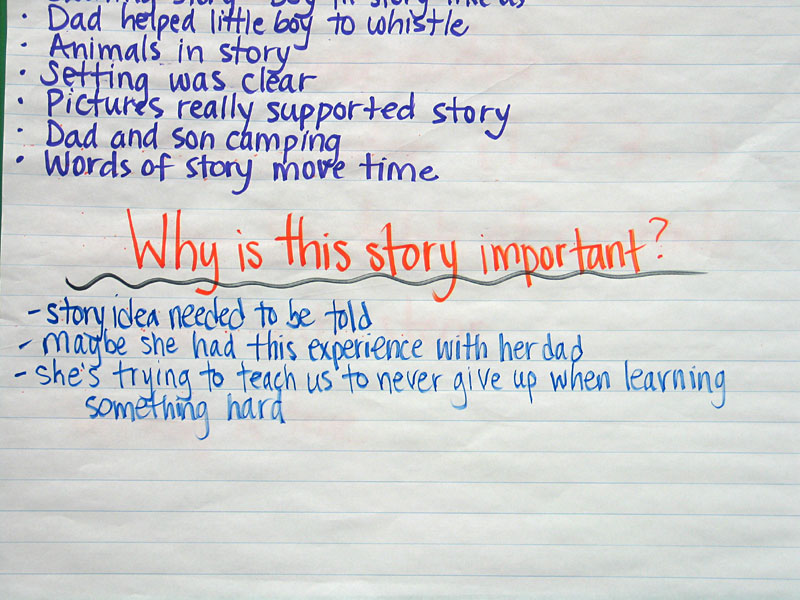
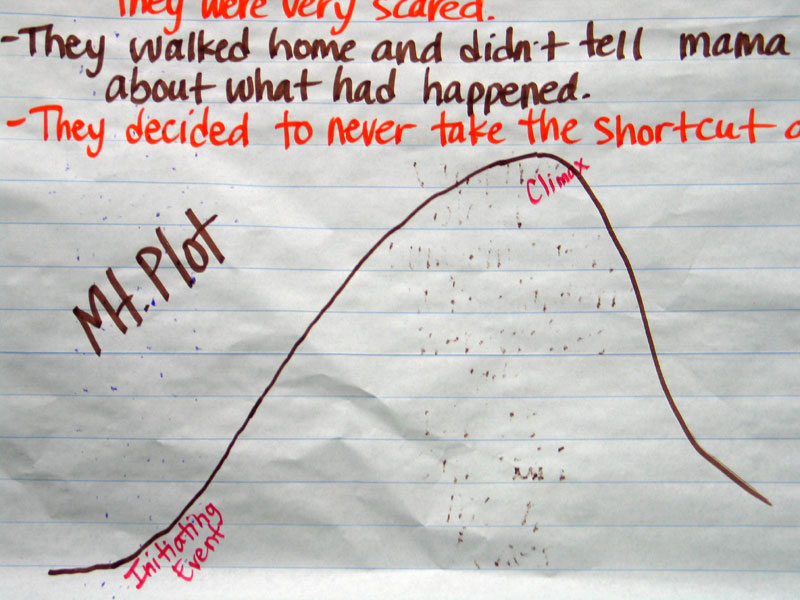
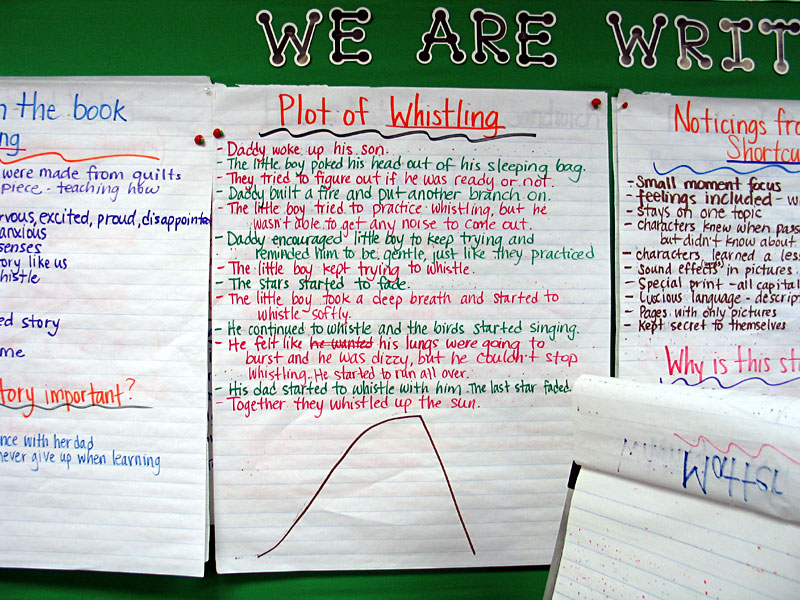
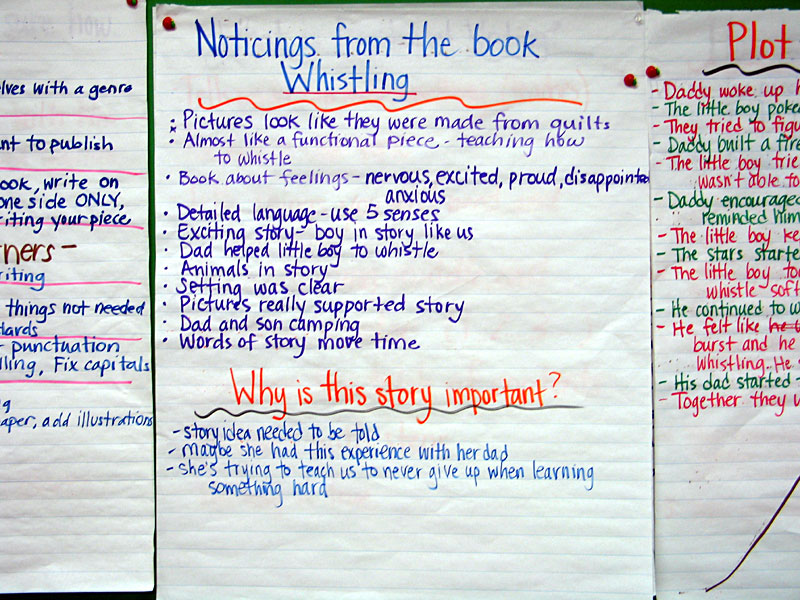
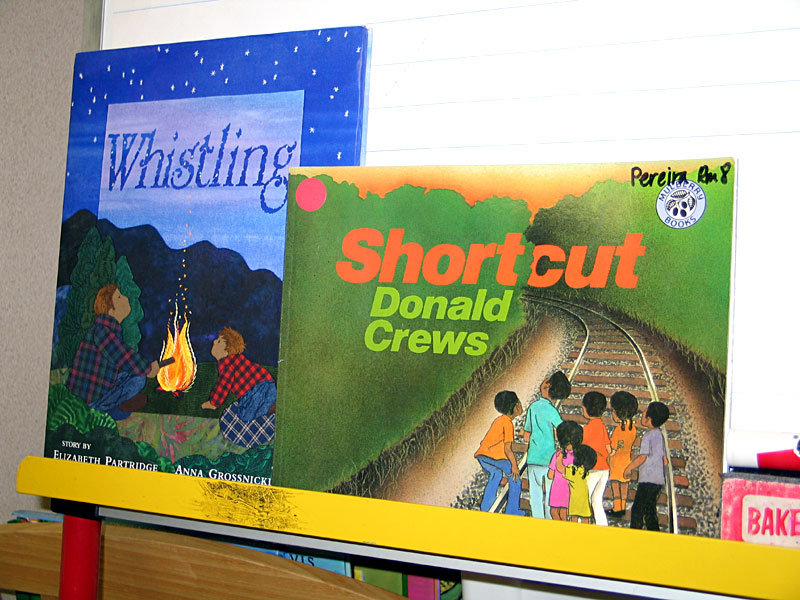
| TEACHER: | Well, we can go back to our conversations that we had about our two books, Whistling and Short Cut and thinking about the answers that they came up with with their and asking them, okay, so did we say that the author might have written this because it had a lot of feelings? No, we didn't. that's not something that we recorded on our chart. Did we say that the author wrote it because it had a lot of details? No. Okay, so what did we say, and look to those things also in hopes that that could spur them on in their own thinking about their own events and, oh yeah, okay. So yeah it did have a lot of feeling and that's important but what's the big deal? Why is this event something that I need to share? |
| MOD: | And what are your hopes for this class as writers? |
| TEACHER: | I have a really great class this year and they are probably some of the highest writers actually that I've had the pleasure of working with. So I hope that when we start actually writing our drafts that they'll be able to incorporate the significance, this hard work that we're doing now, into their final pieces. Some of my colleagues that are a little bit ahead of me have told me that they've been a little frustrated by that because they did all this work with significance and then going back and reading their drafts, a lot of the kids have left it out. So I'm hoping that we'll be able to craft some lessons in such a way that we really can get that significance into their writing and have them really understand that that's part of narrative. And as they're - you know, in the future - I guess what my hope is that they'll apply this learning to future work too and it's not just something that's going be gone as soon as this publishing's finished and that it will really affect them as writers and make them better overall. |