Clip Description
Immediately before Becky began writer's workshop on this day, visitors from the Carnegie Foundation asked her about what she anticipated covering with the students and about the emphasis of today's work.Commentary
What is Reflection?(from Johns Hopkins University's statement on Professional Development)
Reflection has many definitions in the context of teacher cognition. Reflection involves "a state of doubt, hesitation, perplexity, or mental difficulty, in which thinking originates". This uncertainty is followed by the act of searching to find materials that will resolve this doubt and settle the perplexity (Dewey, 1933).
Reflection, however, is more that "just thinking hard about what you do" (Bullough and Gitlin,1995). Reflective practitioners give careful attention to their experiences and how meaning is made and justified. They analyze the influence of context and how they shape human behavior.
Critical reflection goes beyond the technical aspects of an experience to the personal, ethical, and political dimensions of teaching. Reflection is about social justice, equity, and change. Reflection is inquiry into pedagogy and curriculum, the underlying assumptions and consequences of these actions, and the moral implications of these actions in the structure of schooling (Liston & Zeichner, 1987).
Becoming reflective requires active engagement or consciousness in the experience, and in this case, the act of narrative writing. Reflection requires the ability to analyze and prioritize issues, to use tacit and resource-based knowledge, and to develop a feasible plan of action. Clarke (1995) suggests that reflection is not about a single event in time, but occurs over time as teachers begin to construct meaning for themselves.
Transcript
| VISITOR: | What is your plan for writing workshop today? |
| TEACHER: | Today in writing workshop I intend to ask the children why the topic they selected yesterday is important to them, and asking them to go to the next blank page in their source book and actually write the why, not continue writing the specific story that they selected but why the topic is important to them. |
| VISITOR: | What do you want the students to learn and how will you know if they've learned it? What will you look for? |
| TEACHER: | I will look, number one, to see whether they're able to identify why the event was important to them, and I anticipate that that actually will be kind of tricky for some of them and then so in my conferences I've kind of been thinking through - I may have to ask why and keep going, well, what's the big deal about that?, with some of them to really get them to think deeply about the event that they've selected from their life search and why it's important. |
| VISITOR: | What have you been doing during your reading time that has prepared students for what you're working on today during writer's workshop? |
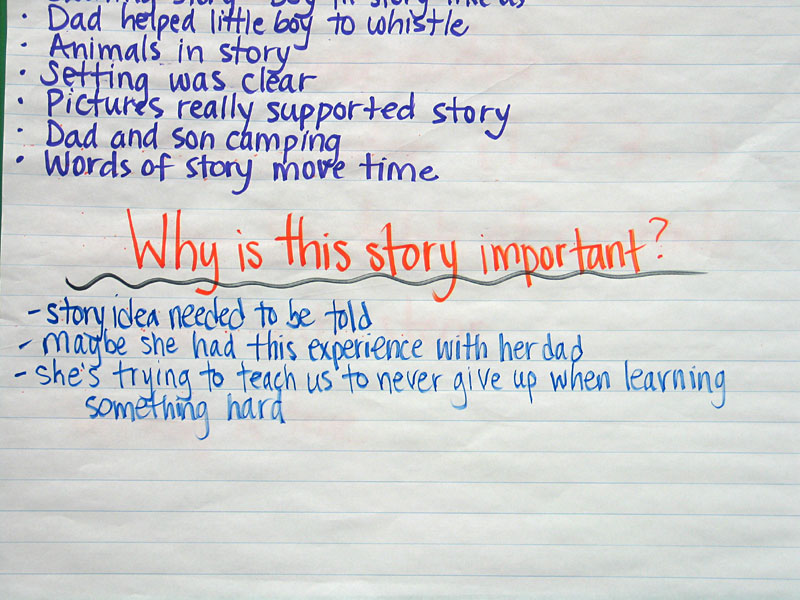
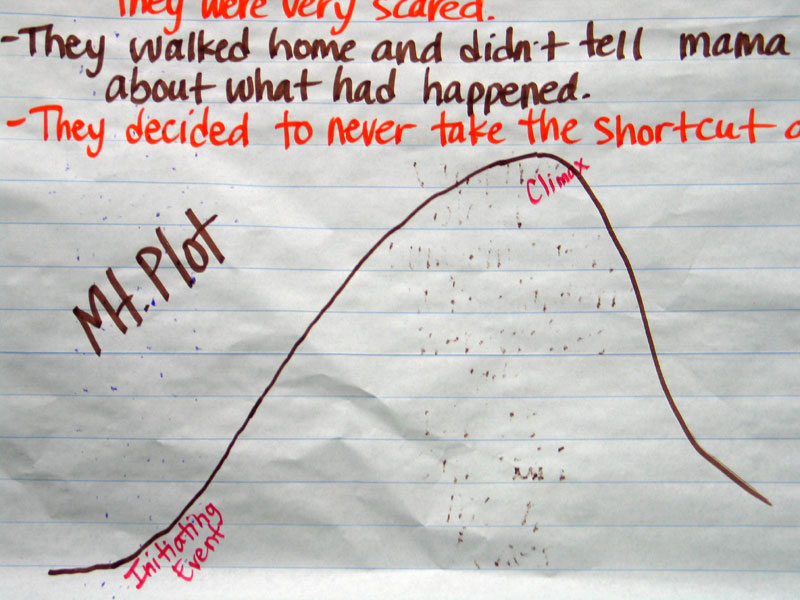
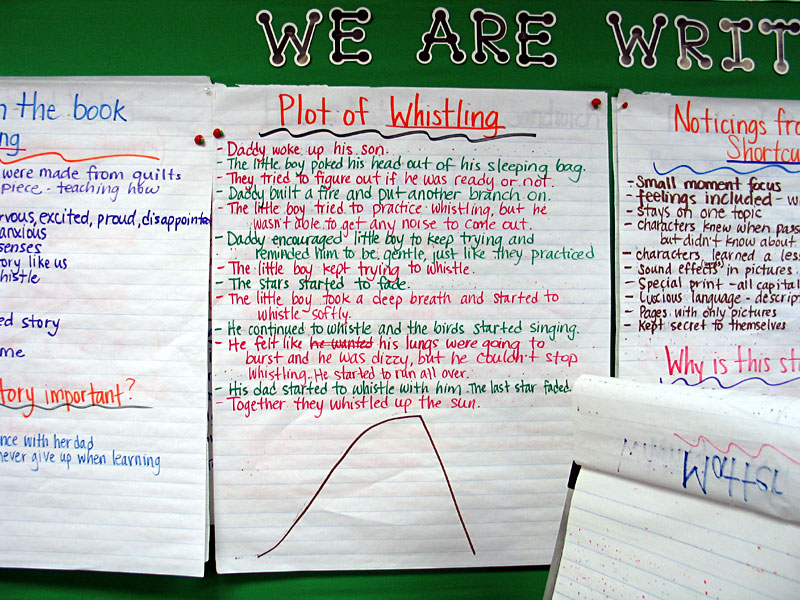
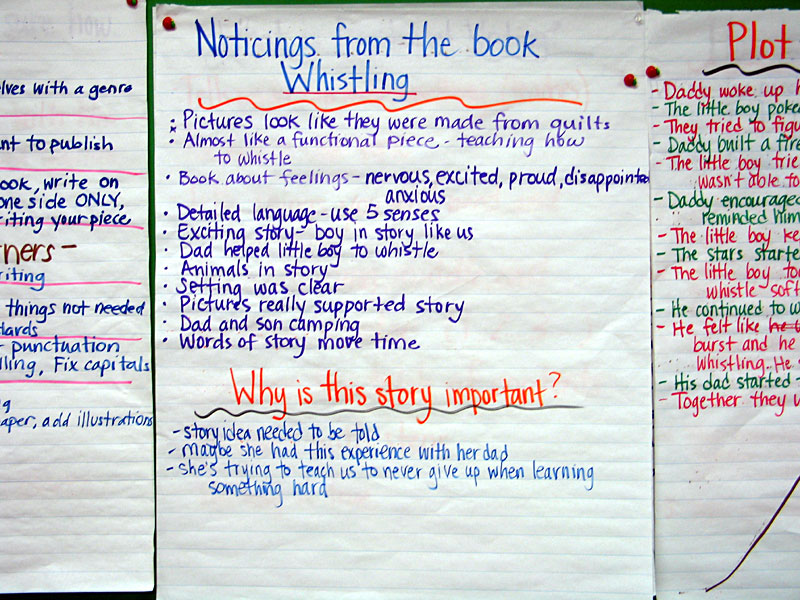
| TEACHER: | During the reading time a lot of our mini lessons lately actually are documented on the charts right here but we've looked through several personal narrative books and we've gone through and just kind of looked at what are some of the components of narrative are, some of the events that they noticed that it happened, and then we went through and asked why they thought those stories were important to the writer. And we came up with some ideas but they also discovered that they weren't sure they were right or not. So that became something else that actually will come into our mini lesson today because they are the writers, they are the authors of their own themes today. It'll be within themselves that they need to figure out why it's important. |
| VISITOR: | What have you been doing during your writing time that has prepared students for what you're looking today during writer's workshop? |
| TEACHER: | The last several days in writing workshop we have been doing a lot of story telling, we've been doing a lot of collecting of ideas in their writing. We started referring to our pieces of writing in our source book as briefs. That seemed to help them figure out that they didn't have to get the entire story down, that they could write just a chunk of it, that would be enough to remind themselves of the event that they wanted to possibly publish. So the have been writing briefs, and so we'll refer to their writing today as briefs also. Then yesterday they took a look at all of their briefs that they had written and reread them and decided which one that they wanted to then publish. So some of the questions that we had asked were, which do you have more to tell about, which do you want other people to be able to see and - |