Clip Description
In this final "teach" part of the mini-lesson, I model using the book we just read as a mentor text. I read an excerpt from my own writing, and I make a plan to try a new technique. I conclude the mini-lesson by giving the students the same task to try in their own writing.
Commentary
I believe this clip is a good example of how to use a mini-lesson to model yourself as a writer to students. It is critical that they see you as a fellow writer in the thick of the writing process struggle. I consistently refer to my writing notebook in my mini-lessons, and I often use my own writing as an example.
This clip also demonstrates how my students see themselves as qualified writers who can give me writing advice. I encourage my students to give me feedback on my writing just as I give them feedback on their work. I try to show my students that I am not a perfect writer, but rather, one who is working through the challenges and difficulties of writing right along with them.
Transcript
| TEACHER: |
I want to show you something you can do and I'm going to do it with my writing. Okay? So - you know how I told you I just visited my mom last weekend for her seventy-fifth birthday, it was a surprise. And I've been trying to write a little bit about that because it was a very special thing for me and I've written a lot about my dad. Remember how I told you I wrote this whole thing about the train trip with my dad and I'm still working on it. I think family is very important to me in my writing so I've been trying to write about my family. But, you know what, a lot of times when I write about my family I feel like all I'm doing is just kind of telling a story of something that we did. I can't figure out what the significance is. So I'm trying to figure out how I can take something that I wrote about my mom and make it significant. And I'm thinking that Libba Moore Gray did that with her mom. She just took something she did with her mom, she danced with her mom and she took that and made it into something really significant. So I'm trying to figure out if I can do that with my writing.
So let me read you something that I wrote about my mom. I wrote - first I wrote this and this is what I'm talking about. I feel like all I'm doing is telling a story. On Friday night I caught a plane to Denver for my mom's seventy-fifth birthday. I was going to surprise her but she surprised me instead. My flight was late and when my dad kept driving around the airport, she got frustrated and bossy. She decided to jump out and check for me in the airport. So she got out of the car, came into the airport and she waited behind some bushes until I came up the escalator. Then she jumped out when I walked by. How could this happen? She surprised me. I was supposed to surprise her. Can you believe that happened? I was surprising her and she surprised me. So I read that and I thought, well it's, you know, it's kind of cute story but I don't know it's just - it's just a story. I'm trying to get to the significance about what it is about my mom. So then I started thinking well what is it that I'm thankful for about my mom and I started making a list. So I listed all these things that I love about my mom because I was kind of thinking of Libba Moore Gray. It sounds like she was kind of writing about what she loves about her mom. So I wrote these things that I love about my mom. Laughter, she can talk to anyone. My mom can go up to anybody and start a conversation and I mean anybody. It's amazing. She compliments people all the time, me included. She's very selfless, she's polite. She used to be a teacher so she's always trying to teach kids. She's a good cook, she loves animals, she sings, but she's not a very good singer. |
| TEACHER: | But I love that about her because she sings out of key. And she has all these phrases. She has this one phrase that I love. She always says, okay world, like when she's getting ready to do something. So I wrote all that and I thought okay now I'm getting somewhere, now I'm starting to get to the significance. Kind of like Libba Moore Gray. So I was thinking maybe what I should do is I should try to write something like her. And maybe I would try this technique where she just writes one line at the beginning and then ends it. So what I'm thinking is I'm going to write a story about my mom using this stuff and I'm going to start by saying something like, my mom has a smile that can light up a room. Or my mom can talk to anyone and make them happy. Or my mom sings all the time but it's out of key. So I'm just trying to experiment with some of those. I'm still not sure which one I'm going to use yet. But I'm going to try that in my writing notebook. I'm going to try some different lines. And I'm going to try to think if I could do the same thing Libba Moore Gray did. I could start the story with that line and then go into maybe the story about her seventy-fifth birthday and then go back again to the end and put that same line at the end. And see if it sort of matches the significance that Libba Moore Gray got across. Nicole? |
| STUDENT: | Maybe for the first line you can do, hello world. Maybe that - like and put it in quotes. |
| TEACHER: | Right, like something that she says? |
| STUDENT: | Yeah. |
| TEACHER: | Hello world. Thank you, yeah. I might even try that. And starting with that and then just describe her and then somehow weave that quote into it? |
| STUDENT: | Yeah. |
| TEACHER: | Great, thank you for the suggestion. |
| STUDENT: | I agree with Nicole and do that and probably have it a couple of more times in the book. Like every time [unclear] and she always did that kind of day like - |
| TEACHER: | Right. |
| STUDENT: | - hello world and then do stuff on each page or something. |
| TEACHER |
Great, great idea. So now what Nicole and Haley are helping me to do is, I'm taking Libba Moore Gray's book and I'm using it to help me do some writing. And that's called using this book as a mentor text. A mentor is somebody that you look up to to teach you something. So I might use this as a mentor text. I might take the idea that Libba Moore Gray used and put it in my own writing and try to see if I can make it work. And what I want you to do today is, I want you to try this yourself.
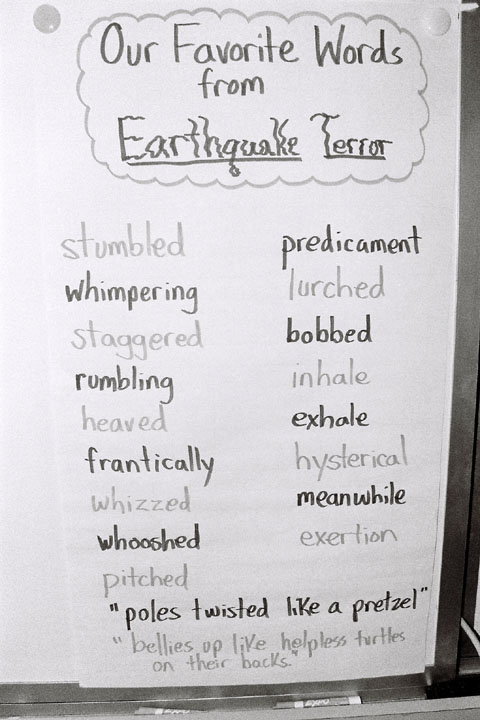
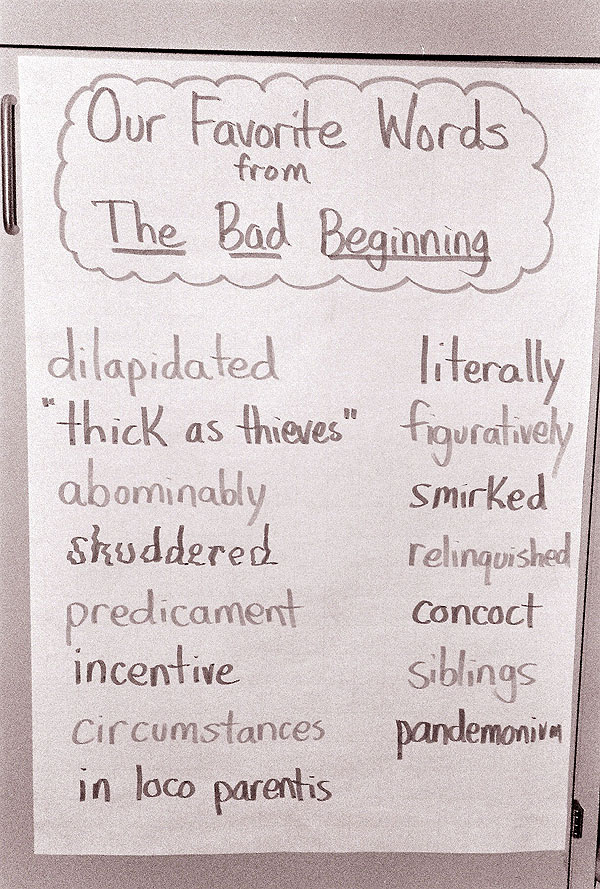
So we got all these books that we've read, all the books here, My Rotten Redheaded Older Brother [by Patricia Polacco], Chato's Kitchen [by Gary Soto], Earthquake Terror [by Peg Kehret]. I even put The Bad Beginning here because good old Lemony Snicket has some great writing techniques that you might want to use that we talked about before and also Owen and Mzee [by Isabella Hatkoff, Craig Hatkoff and Dr. Paula Kahumbu], okay? So you can use all these books or you can even think of another book that you've read. But I want you to think about a book that you've read and think about a strategy that a writer has used and try to see if you can put it into your writing somehow today. Okay? |